Blend replaced a legacy search tool on bonanza.org with Azure AI Search, adding content weighting, model-based filtering, and verified answers for ABS members.
No one will ever accuse the American Bonanza Society (ABS) of being light on content. It’s one of the biggest benefits of membership: ABS has spent decades building one of the most comprehensive resources for Bonanza and Beechcraft aircraft owners on the web — including repair manuals, magazine archives, forum threads, training resources, and safety guidance, some of it dating back to the 1940s.
Members come to the site because they know the answer is there somewhere. The challenge was helping them find it.
When search results are relevant but still unhelpful.
When the ABS site was built a decade ago, the resources available for search were still messy and incomplete. Which means when a member searched for something specific — a maintenance question, a part, a procedure for a particular model — the results weren't wrong, exactly. They were just overwhelming.
The existing search wasn't broken in the traditional sense. It was doing what it was built to do. The problem was that it had no way to understand the difference between content that mentioned something and content that answered something. Because nearly every resource on the site is technically relevant to nearly every query, a forum post that happened to mention a model number thirty times could outrank a magazine article written specifically about that model. There was a lot of signal and not enough way to sort it.
Solving this meant giving the search engine more context about the content it was indexing and the people doing the searching.
How Azure AI Search solved the relevancy problem.
Through discovery, we narrowed down the needs of ABS’s new search tool. Blend started with a research phase — reviewing how search was actually being used on the site, where it was working, and where members were most likely to hit a wall. That work led to a clear recommendation: replace the legacy search implementation with Azure AI Search.
Where the previous solution required extensive manual configuration to approximate intelligent relevancy, Azure AI Search brings AI-assisted scoring to the problem — better suited to a large, dense, topically narrow content library where almost everything matches almost every query.
The new implementation introduced four specific improvements that together address the relevancy problem:
- Content type weighting gave ABS-produced content — magazine articles, official documentation, staff-written resources — priority in default results, so vetted material surfaces ahead of unverified forum posts when a member needs a reliable answer.
- Model-based filtering added aircraft model as a weighted search parameter. Members with a Beechcraft model assigned to their profile get this applied automatically, so results are filtered toward the aircraft they actually fly.
- Official answer promotion allows ABS to assign “verified” answers, which will weigh higher in results. This allows community knowledge to rise to the top, but only when it's been reviewed.
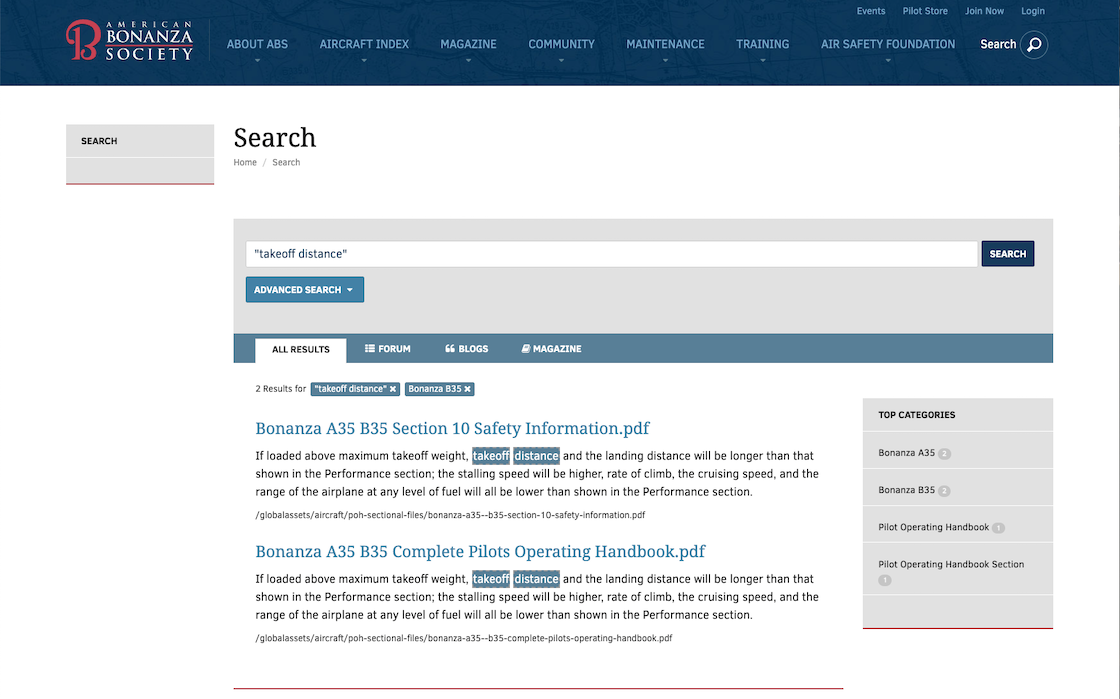
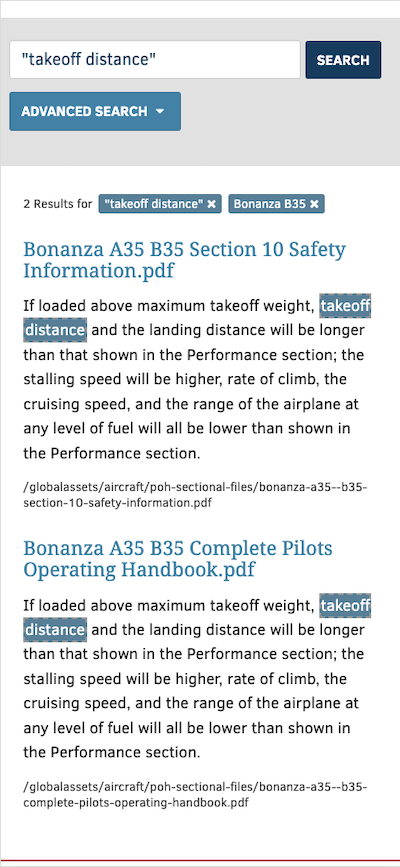
- Search snippets replaced static summaries in results, showing the specific passage that matched the query rather than a generic page description.